
Welcome to Physics!
Optics, light and seeing the world anew!
On-Line Physics Text book: Giancoli Physics.
Week 1 (Sept. 14) Looking at reflections in mirrors
Learning objectives:
- The Ray Model of light
- Flat mirrors introduce us to terms such as image, objects and angles of incidence and reflection.
- Measuring angles based on the Normal
- Symbols such as Di, Do and their meaning
- The Lens equation and hot image distance, object distance, center of curvature and focal point are related to each other.
- Using the Lens equation to solve for one element, given the other three.
- Uncertainty in measurement and calculations
New Assignments:
- The Flat Mirror Lab: Students placed flat mirrors upright on sheets of paper and then considered ‘lines of sight’ as they viewed the reflected images. From this we traced out where the image ‘appears’ to have come from and compare the distances from the mirror to the ‘object’ as well as from the mirror to the ‘image’. We then identified and traced out the Normal lines for reference from which we measured the ‘angles of incidence’ and the ‘angles of reflection’.
- Video: Extreme Ultra Violet Photolithography. Students were to take one page of CWYC notes (we watched the first 20 minutes or so) and then turn them into Messy Notes: Due Friday.
- Concave mirror lab/Poster Project: Introduction to optics with ray diagrams and mirrors. This lab involved students placing candles at several distances in front a concave mirror and then looking for the projected image on a screen. Once the images came into focus, we measured the image and object distances and then, using the Optics equation, calculated what the focal length, f must have been. Posters Due Next Friday
Monday: Mr. Clark simply met the students and spoke a bit about his own background in Factory Automation and his journey through school and engineering.
Tuesday: we continued with some discussion about how to take notes (a Love Story!) and then jumped into the Flat mirror lab which primarily introduced students to the terms we would be using in our discussions of Optics. Students simply had to submit the notes from class and their first ‘Ray diagrams’ showing how and where and image forms in a flat mirror.
Wednesday: We started with a short video highlighting a machine which uses Extreme Ultraviolet light to print microchips. Students were to take notes: We then continued with Geometric Optics but began exploring how concave mirrors form images which can be projected onto screens. As part of this discussion, new terms were introduced such as the Center of curvature and the focal point/plane/distance. Of special interest was the transition from ‘Real Images’ (if the object is OUTSIDE of the focal point and Virtual Images if the object is INSIDE the focal point. From these observations we then used the Optics equation to calculate the Focal length of these mirrors.
Thursday: We set up our ‘lab apparatus’ to create Real Images with Candles and Spherical Mirrors. Clark walked through how to create Ray Diagrams to better understand where and how images will form. Students first simply looked for combinations which produced images on screens and then Clark brought in the Lens Equation so that we could Calculate what the Focal Length must be for that mirror. (note: Though the Object and Image distances CAN change, the Focal Length is fixed and is a function of the Radius of Curvature). Additionally, Clark introduced the concept of Uncertainty in Measurement and how we quantify the resulting Uncertainty in our final, calculated values.
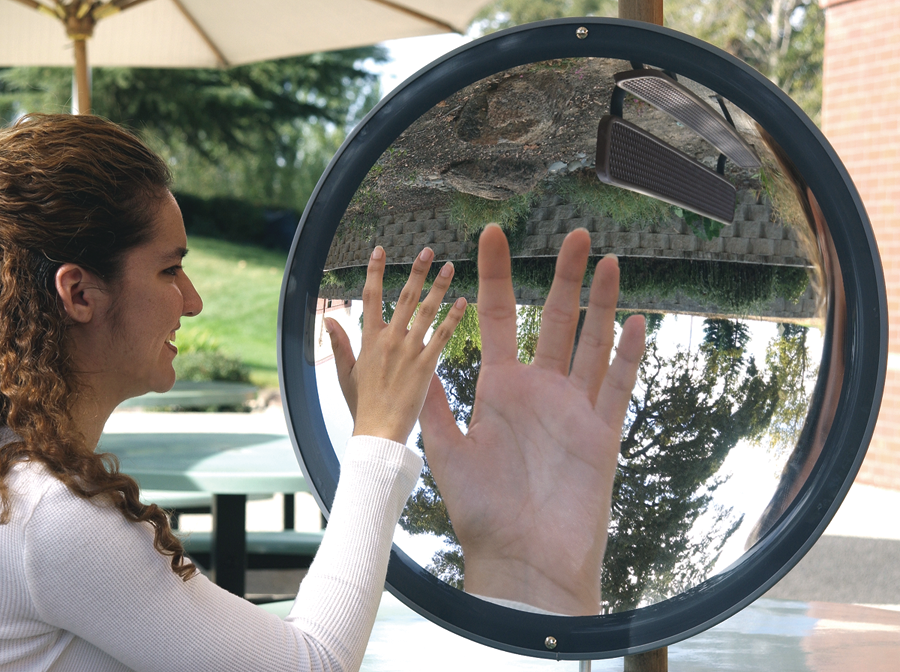
Friday: We continued with yesterday’s lab to determine through measurement and calculation, the focal length of the Spherical mirrors in class. Clark took a bit more time to discuss the concept of Uncertainty in measurement and how to carry that uncertainty through the calculations to determine the uncertainty in the final answer. We also went outside with sunglasses to see directly, the focus on the giant, class mirror (using a mister bottle worked great for this).
Week 2 (Sept. 21) From Reflection to Refraction!
Learning objectives:
- Refraction of light as it passes through different substances.
- The Index of Refraction and Snell’s law.
- The evolution of our understanding of light and how we perceive it including the contribution of Euclid and Newton.
- How are cones and optic nerve are evolved to perceive color (why do we see Yellow when only Green and Blue are present?)
Monday: We passed out the book Catching the Light and spoke about upcoming Socratic Seminars. Also reviewed was how to draw Ray Diagrams for Virtual Images (such as when someone holds an object within the focal length of a spherical mirror. Also highlighted was the on-line physics text by Giancoli, which students can (and should!) use as a reference for our study of Geometric Optics. (chapter 23 contains all of the examples of Ray Diagrams that Clark went through in class, for example).
New Assignments:
- Messy Notes: Structure and function of the eye and video notes: Light and Dark (notes due on Friday)
- Index of refraction of Lucite: Students viewed ‘lines of site’ or pairs of nails and then use protractors to determine the Incident and Refracted rays. From this data set, we were able to use SNELLS LAW to determine what the Index of Refraction must be for Lucite, as well as the Speed of Light through Lucite.
- Messy Notes: Fabric of the Cosmos: What is Space? (just the first half of the video which introduces students to Einstein’s view of Space and Time, which are tied together through the Speed of Light. Due on Monday
- Socratic Seminar (Tues and Thurs). Students are to prepare 10 questions to ask and hand in to Clark on their respective days (see lists below).
Tuesday: The First half of class, Clark first demonstrated with a 3-color LED how our perceptions of light and color are more complicated than ‘first meets the eye’. This website, Structure and Function of the eye describes it all. From here, we watched the first 30 minutes of the BBC documentary; Light and Dark Students were required to take notes on the discussion and the film (we’ll finish the video tomorrow). (messy notes due on Friday). The remaining time in the period was for students to work on the first Light and Reflection poster project (Due on Friday)
Wednesday: Clark first reviewed his Grading Rubric for all major projects (for students to keep in mind for this first, Poster Project on Light). Clark then introduced the concept of Refraction and how light rays, as they move from one medium to the next, will change speeds and as a result, will change direction. This then led to our refraction lab in which students looked at light as it passed through semispherical blocks of Lucite and through measurement and application of Snells Law, we calculated the Index of Refraction and then the speed of light through the material.
Thursday: Clark began by reviewing the concept of Refraction and how the speed of Light (C) is only Constant in the vacuum of Space. Once the light enters any material, the light must slow down as it interacts with the molecules of the material. In the video clip (at right): What is Total Internal Reflection, we can see how an incident ray will change directions as it enters or exits a new medium.
Friday: Class began with Clark discussing how neurons in the brain are pruned back when not utilized. The research around this comes mostly from studies of how we acquire language and can be seen in examples such as Japanese people having a hard time distinguishing between L sounds and R sounds. This is because the Japanese language doesn’t have either of these sounds.. so they literally can’t hear the difference or reproduce the sounds without years of practice (to grow new neurons). From here we discussed the upcoming Socratic Seminars on the book, Catching the Light. (see list of presenters below). The conversation then turned back to the Speed of Light, C and how Light is viewed by all observers at that speed, regardless of speed of the source or the viewer. This phenomena is best described in the 30 minute Video: What is Space? Narrated by Brian Green. Students were to take CWYC notes today (or Messy Notes on Monday for extra credit).
- TUESDAY SOCRATIC SEMINAR people: Bryce & Tara, G., Alex P., Lillian P., Josie S., Abby S., Charlotte W., Ruby W.
- THURSDAY SOCRATIC SEMINAR people. Mila A., Jadyn C., Ace R. Isabella L., Camille R., Jenner S. Natalie T., Emma W.


Week 3 (Sept 28) How can we take photographs of Black Holes?
Learning Objectives for this week
- The Socratic Seminar
- How does Very Long Baseline Interferometry work?
Additional Topics of Interest
New Assignments this week.
- Lenses, refraction and black holes_Poster Project Due Next Monday.
- Messy Notes: How do we photograph a Black Hole? Due on Friday of this week.
Socratic Seminar Contributors for This week.
- Tuesday: Sept 29: Bryce & Tara, G., Alex P., Lillian P., Josie S., Abby S., Charlotte W., Ruby W.
- Thursday: October 01: Mila A., Jadyn C., Ace R. Isabella L., Camille R., Jenner S. Natalie T., Emma W.
Monday: On Monday, Clark first introduced the idea that Lenses, unlike Spherical Mirrors, have two focal points (equally spaced on each side of the lens).. and that it doesn’t matter to the lens which way light is passing through it. We then set up our Optical Benches in the same fashion as last time and had students repeat the same set of experiments, all designed to Calculate the Focal Length of the lens through multiple trials pairing Images generated by placing the Candle at different locations.
Tuesday: Today began with the Socratic Seminar (student presenters listed above).. Once finished, students took their respective lenses to measure directly, the focal length by pointing their lenses at the Sun and measuring the distance to the ‘bright spot’ (noting uncertainty again). As our last point of Interest today, we watched a 20 minute video showing how scientists recently took a photograph of a Black Hole using Very Long Baseline Interferometry. (Messy Notes required, due on Friday).
Wednesday: We started with picking up the last 10 minutes of the 20 min. Video: How we photographed a Black Hole. From here, Clark demonstrated how to measure the Image distance to the Magnified and Virtual Image created by a magnifying glass so that students could start working on their next Poster Project,
Thursday: We first began with our Socratic Seminar which took about 30 minutes. We then just had ‘work time’ to give students a chance to get caught up on missing work and make progress on the current, poster project from last week.
Friday: Clark announced next week’s Socratic Seminar participants for next Tuesday
- Tuesday, Oct. 6th: (should have read THROUGH chapter 6.) Malena C., Jadyn R, Olivia D, Abbey F, Luis F, Mary K, Charlie L, Paloma
- Wednesday, Oct 14th: (should have read THROUGH chapter 8) Allyn M, Scarlett M., Ursa M, Emily S, Nils T, Natalia W, Tristan W., Nahara G,
Week 4: Light and the atmosphere
Learning Objectives:
- Refraction and Snell’s law: how to predict the path of a light ray through a substance
- Transmission of light through the Atmosphere as a function of wavelength.
- How Earth’s atmosphere interacts with solar radiation both incoming and outgoing back into Space.
- How does a LASER work?
- What can we do with X-Ray LASERS?
New Assignments:
- rays through a lens with inv sin
- video: Particle Fever (students were to take ‘messy notes’)
Resources for Urays through a lens with inv sinncertainty, Significant Figures and Measurement
- See how a glass rod disappears into a container of Glycerin due to them both having the same refractive index
- Giancoli on-line text; (section 1-4: Measurement and Uncertainty; Significant Figures. )
- LibreText on-line chapter 1.8: Measurement and Significant Figures
- LibreText on-line chapter 2.4: Significant Figures in Calulations.
Monday– Clark passed back papers and reminded students that this Main Block session is wrapping up. TO DO.. includes beginning work on your Title page and end-of-block Reflection. Getting back to Refraction, Clark showed students this interesting short clip showing how a glass rod seems to disappear into a glass of Glycerin due to the fact that they both have the same refractive index. Additionally, Clark passed out a practice refraction/Snell’s law practice sheet in which students are to predict the path of several rays of light as they pass into a lens. Clark also pulled aside ‘struggling students’ for some one-on-one check-in time.
Tuesday: We began today by taking a look at this year’s Nobel Prize winner for Medicine in which researchers at Stanford were able to genetically engineer brain cells to respond to light thereby allowing them to control when Neurons fire and better understand how brain processes work.
Clark showed students a slide illustrating how various frequencies of light can penetrate or be absorbed by the atmosphere highlighting how the Green House Effect actually is a function of frequency of light and atmospheric composition.
Wednesday: What is a LASER? and How does the SLAC X-Ray LASER work?
Thursday: Clark passed out the Review Guide for next week’s test and spoke a bit about The Large Hadron Collider in Europe. In this machine, physicists accelerate Lead atomic nuclei to 99.99% the speed of light and collide them in head-on collisions.. Through four, different detectors, we have finally discovered the Higgs Boson and brought together the Standard Model for particle physics. We then watched the first half of the video: Particle Fever (Amazon Prime)

The Atmospheric Window: Which colors of light does our atmosphere allow through?
This page also shows which gasses, specifically, absorb various frequencies.
Week 5 (Oct. 12) Modern Physics and colliding atoms at the speed of light!
Learning Objectives:
- How do rainbows form?
- The Large Hadron Collider: What were they hoping to find?
New Assignments:
- Nothing new this week: We had our last Socratic Seminar and Finished up watching Particle Fever, at least through the point when they finally achieved the goal of colliding atoms together to create new particles including the Higgs Boson.
- As a reminder: Students will be given Extra Credit on the Test if they prepare a handwritten set of notes demonstrating they looked at the review guide and studied.
Monday and Tuesday were holidays.
Wednesday. We had our final, Socratic Seminar this morning. Part of the conversation was about Rainbows and whether or not everyone is seeing the same thing. Clark then came back and went through an overview of the Physics of Rainbows and how two people across town from each other are NOT seeing the SAME Rainbow since the geometry requires they be looking at different sets of rain drops.
NOTE TO CLARK! FOR NEXT BLOCK: SEARCHING FOR RAINBOW LAB: Get a bunch of spray bottles!!
Thursday is a Work Day
Friday is the End of Unit Test: Review Guide_Optics test _ Doran block2
